Publication
Field Validated Hybrid ESP-NOW and Long Range IoT Monitoring System for Energy Autonomous Precision Agriculture
Ali Abdelli, Wissem Boujnah, Younes Ben Salah, Khaled Issa, Hatem Garrab, Sarvar Hussain Nengroo, Mohsen Machhout, and Kyungsu Lee. "Field Validated Hybrid ESP-NOW and Long Range IoT Monitoring System for Energy Autonomous Precision Agriculture," IEEE Access (Access) , 2025.
Abstract
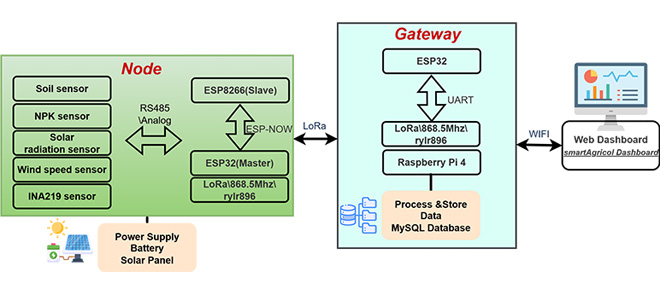
Agriculture in arid and semi-arid regions faces critical challenges of water scarcity, irregular rainfall, and the high cost of monitoring systems. Most existing Internet of Things (IoT) platforms for precision agriculture are expensive, energy-intensive, and rely on cellular or grid connectivity, which limits their adoption by smallholder farmers. To overcome these issues, this work presents a hybrid Espressif peer-to-peer protocol (ESP-NOW) / long range (LoRa) IoT monitoring system. The architecture combines ESP8266 sensor nodes, an ESP32 primary aggregator, and a Raspberry Pi 4 gateway, integrating ESP-NOW for local ultra-low-power communication and LoRa for long-range data transmission. In operation, the ESP8266 nodes periodically acquire environmental data and send it via ESP-NOW to the ESP32 primary, which aggregates the packets and forwards them through LoRa to the Raspberry Pi gateway for storage, visualization, and analysis. All sensor data are stored in a MySQL database and visualized in real time through a web dashboard. The sensing modules were calibrated under laboratory conditions using reference instruments to ensure accuracy, achieving correlation coefficients ( R2 ) between 0.95 and 0.97. Field deployment in a Tunisian wheat plot further confirmed stable performance, with less than 3% nighttime battery discharge and a packet delivery ratio above 95% up to 2 km. Costing under 600 EUR, the proposed system provides a validated, scalable, and affordable IoT solution for precision agriculture in resource-constrained environments.