SFXGraph: Causal-Compositional Graph Learning for Stylized Sound Effects in Webtoons
Asian Conference on Computer Vision 2026, 2026.
RESEARCH OVERVIEW
How can AI read stylized sound effects in webtoons?
Lettering in webtoons mixes with artwork and varies in shape. This work represents content, deformation, style, and context as a graph for sound-effect recognition.
Abstract
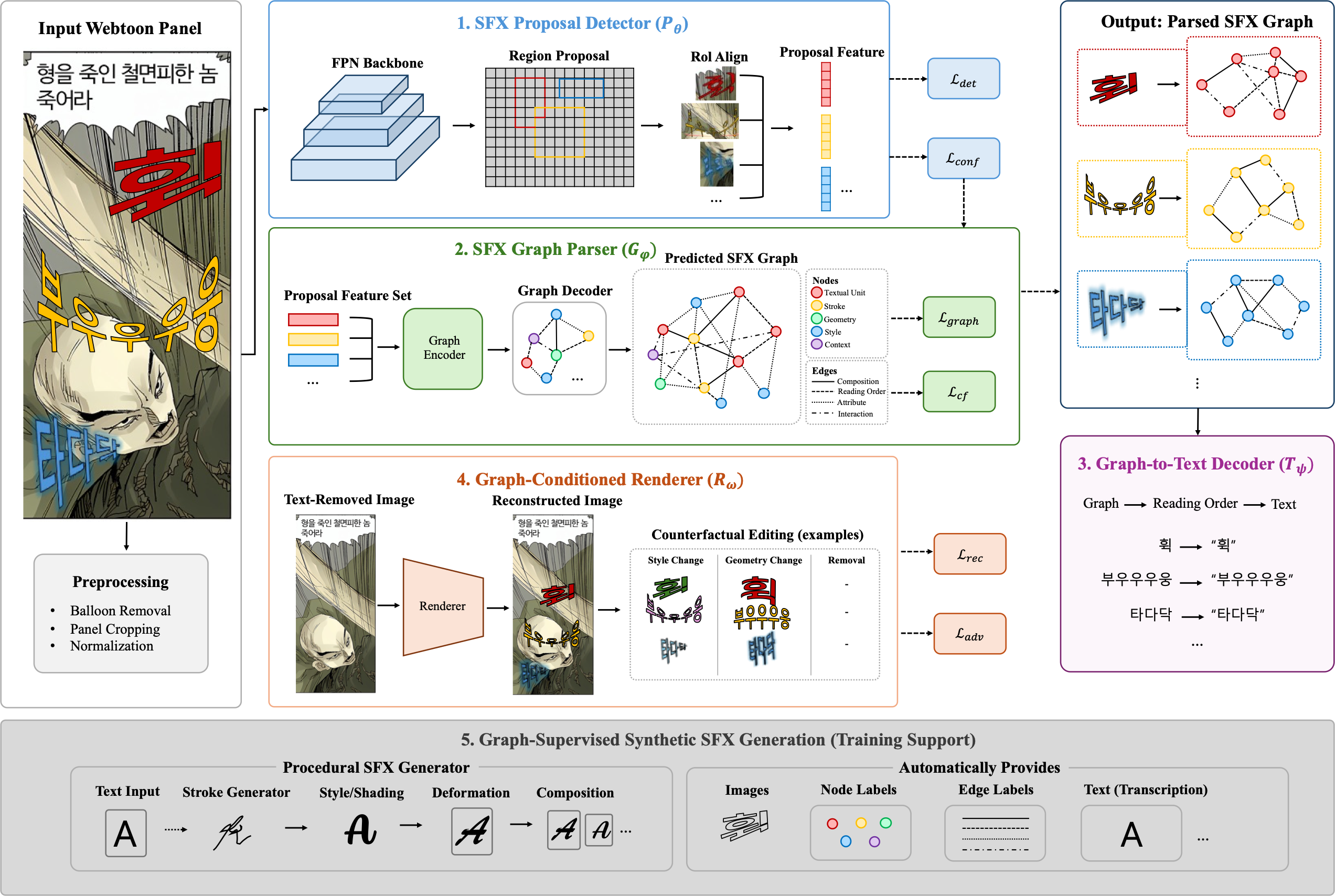
Webtoons, a globally popular form of digital comics, rely on stylized sound effects (SFX) as essential visual cues for actions, emotions, and atmosphere. Since Webtoon SFX tightly entangle linguistic content, geometry, style, and scene context, conventional optical character recognition (OCR) systems designed for regular text often fail on these highly stylized effects. We propose SFXGraph, a causal-compositional graph parsing framework that models each SFX instance as a structured graph of linguistic units, geometric deformation, visual style, and contextual interaction factors, rather than decoding it as a flat text sequence. To learn this representation, we introduce counterfactual factor consistency, which separates scene-invariant content from SFX-induced factors and enforces the predicted graph to be sufficient for SFX removal, reconstruction, and controlled synthesis. We further construct a graph-supervised synthetic SFX generation pipeline that provides dense node, edge, style, and deformation supervision at scale. Experiments on public and custom Webtoon datasets demonstrate that SFXGraph consistently outperforms conventional OCR engines and vision--language baselines, while providing interpretable graph-level representations and stronger robustness to diverse artistic styles.
Framework Overview

Figure 3 from the paper. SFXGraph represents stylized sound effects as structured graphs and uses graph-conditioned rendering and synthetic supervision to support recognition.
Recognition Results
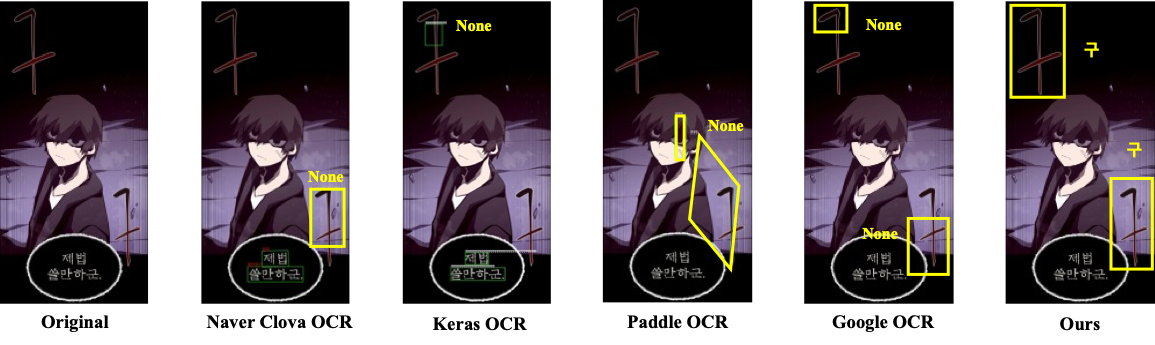
Figure 4 from the paper. From left to right: original panel, Naver Clova OCR, Keras OCR, Paddle OCR, Google OCR, and SFXGraph. Bounding boxes and transcriptions show detection and recognition outputs; “None” indicates a missed detection.