CVPR 2026 논문 채택을 축하합니다Congratulations on CVPR 2026 Acceptance!
We are excited to announce that our paper has been accepted to CVPR 2026: Yeongsu Kim, Seo-Yeon Choi, and Kyungsu Lee, “Human-Intervention Segmentation via Federated Intent Embedding and Multi-Mask Recommendation.”
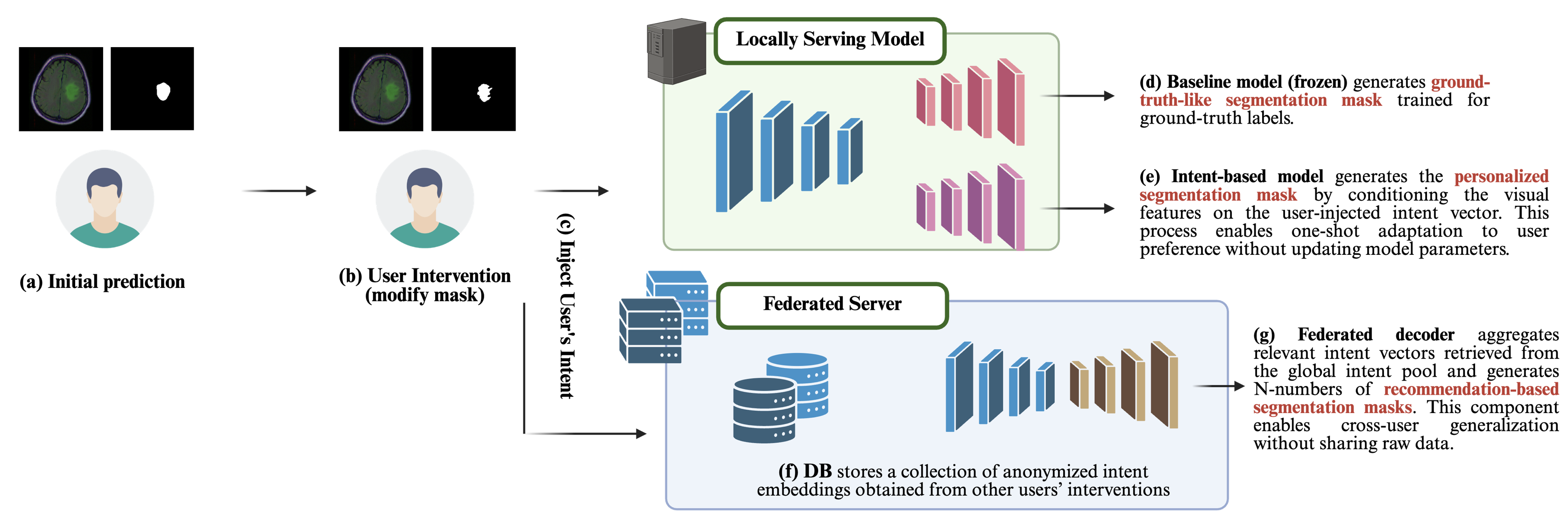
연구실의 논문이 CVPR 2026에 채택되었습니다!
김영수, 최서연, 이경수, 「Human-Intervention Segmentation via Federated Intent Embedding and Multi-Mask Recommendation」.
- 학회: CVPR 2026 (Conference)
- 주제 분야: Vision applications and systems
- 키워드: Computer Vision, Machine Learning, User Experience Design
- 학생 논문: 예
초록
인공지능은 영상의학의 발전을 이끌었지만, 병원과 장비 간 차이는 신뢰성과 신뢰를 저해합니다. 본 연구는 주파수 영역 조화와 지시 조건부 개인화를 결합하여 일관되고 해석 가능한 진단 결과를 제공하는 연합학습 프레임워크를 제안합니다. 라디오믹스 특징을 반영한 FFT 기반 재구성을 활용하여 장비 의존성을 낮추며, CLIP 기반 텍스트 조건화를 통해 의료진이 현장 진료 관행과 환자 요구에 맞게 재구성을 유도할 수 있도록 합니다. 4개 병원에서 영상의학과 의사 15명과 환자 50명을 대상으로 용종 검출, 회전근개 파열 진단, 기흉 분류, 유방암 분류·분할 과제를 평가했습니다. 결과는 과도한 지연 없이 기관 간 전이에서 정확도, 보정, 강건성이 유의하게 향상됨을 보여줍니다. 의료진은 해석 가능성의 향상과 전문적 판단의 자율성 유지를 보고했으며, 환자들은 더 높은 신뢰, 불안 감소, AI 참여에 대한 수용도 향상을 보였습니다. 이 연구는 연합학습을 투명성, 형평성, 신뢰할 수 있는 배포와 결합하여 인간 중심 의료 AI 설계에 기여합니다.
저자들의 뛰어난 연구 성과를 축하합니다.
We are excited to announce that our paper has been accepted to CVPR 2026:
Yeongsu Kim, Seo-Yeon Choi, and Kyungsu Lee, “Human-Intervention Segmentation via Federated Intent Embedding and Multi-Mask Recommendation.”
- Venue: CVPR 2026 (Conference)
- Subject Area: Vision applications and systems
- Keywords: Computer Vision, Machine Learning, User Experience Design
- Student Paper: Yes
Abstract:
Artificial intelligence (AI) has advanced radiology, yet variability across hospitals and devices undermines reliability and trust. We present a federated learning framework that combines frequency-domain harmonization and instruction-conditioned personalization to deliver consistent and interpretable diagnostic outcomes. Using FFT-based reconstructions informed by radiomics descriptors, the system reduces equipment dependency, while CLIP-based text conditioning enables clinicians to guide reconstructions to local practices and patient needs. We evaluated the framework across four hospitals with fifteen radiologists and fifty patients, spanning polyp detection, rotator cuff tear diagnosis, pneumothorax classification, and breast cancer classification/segmentation. Results show significant gains in accuracy, calibration, and robustness under cross-site transfer, without introducing prohibitive latency. Radiologists reported improved interpretability and preserved professional agency, while patients expressed greater trust, reduced anxiety, and stronger acceptance of AI involvement. This work advances a human-centered design for medical AI, aligning federated learning with transparency, equity, and trustworthy deployment.
Congratulations to the authors on this excellent result.